he technical name for these compounds are Per- and Poly-Fluoroalkyl Substances (PFAS). Formerly described as perfluorochemicals (PFCs), PFAS is a better scientific and regulatory acronym because it refers only to the compounds found in water.
PFAS are chains of carbon atoms with fluorine atoms attached at most (poly-fluoro-alkyl-substances) or all (per-fluoro-alkyl-substances) of available carbon bonds. The figure below shows per-fluoro-octanoic-acid (PFOS) one of the more common PFAS.
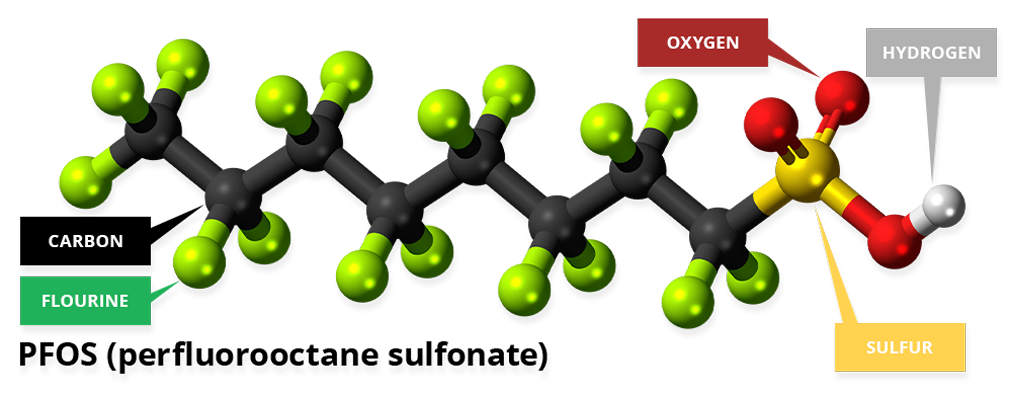
PFAS are a large group of manufactured compounds that are widely used to make everyday products that repel water and oil and are resistant to heat and chemical reactions. Teflon, Stainmaster, and Gore Tex are some of the common trade names for PFAS. PFAS are used in waterproof and stain proof fabrics, non-stick cookware, food packaging, automotive waxes, fire-fighting foams, and in a variety of other industries, including aerospace, automotive, building and construction, and electronics.
Two specific compounds, perfluorooctane sulfonate (PFOS) and perfluorooctanoic acid (PFOA), are released into the environment when products containing Teflon and other PFAS-bearing materials are made, used, or discarded. PFOS is no longer manufactured in the United States, and PFOA production has been reduced and will soon be eliminated; however, foreign-made products may still contain these compounds.
PFAS have been found in water, air, soil, house dust, and blood. People are exposed to PFAS through food, consumer products, and indoor and outdoor air.